
Why are rules necessary?

The Role of Rules, Consent, and Communication in BDSM Practices
In a world where dynamics can reverse roles and intensify sensations, a well-defined framework becomes an essential pillar.

Introduction
BDSM refers to a set of relational practices based on power dynamics, sensations, or control, always framed by mutual consent. Contrary to popular belief, these practices rely on precise rules and transparent communication. A clear framework is not a constraint but an essential condition to guarantee safety, trust, and respect between partners.

Chapter 1: Understanding the Concept of a Framework
1.1 Definition of the Framework
In the context of BDSM, the framework refers to the set of rules, limits, and agreements established between partners before any practice. It includes, in particular:
- Practices that are accepted or prohibited.
- Physical and emotional limits.
- Safe words and their meanings.
- Procedures for stopping or adapting during the session.
1.2 A Reassuring Structure
A well-defined framework offers a solid foundation for the experience. It helps avoid misunderstandings and creates a predictable and secure environment, which is particularly important in dynamics where roles may involve an asymmetry of power.

Chapter 2: The Framework, a Guarantee of Safety
2.1 Physical Safety
Some BDSM practices involve risks. A structured framework makes it possible to:
- Minimize the dangers associated with improvisation.
- Adapt activities to the abilities and health of the participants.
- Establish emergency protocols in case of a problem.
2.2 Emotional Safety
The framework also plays a key role in protecting psychological well-being. It makes it possible to:
- Avoid situations of distress or exceeding personal limits.
- Strengthen the feeling of control, even in submission games.
- Create a space where everyone can express their needs without fear of judgment.
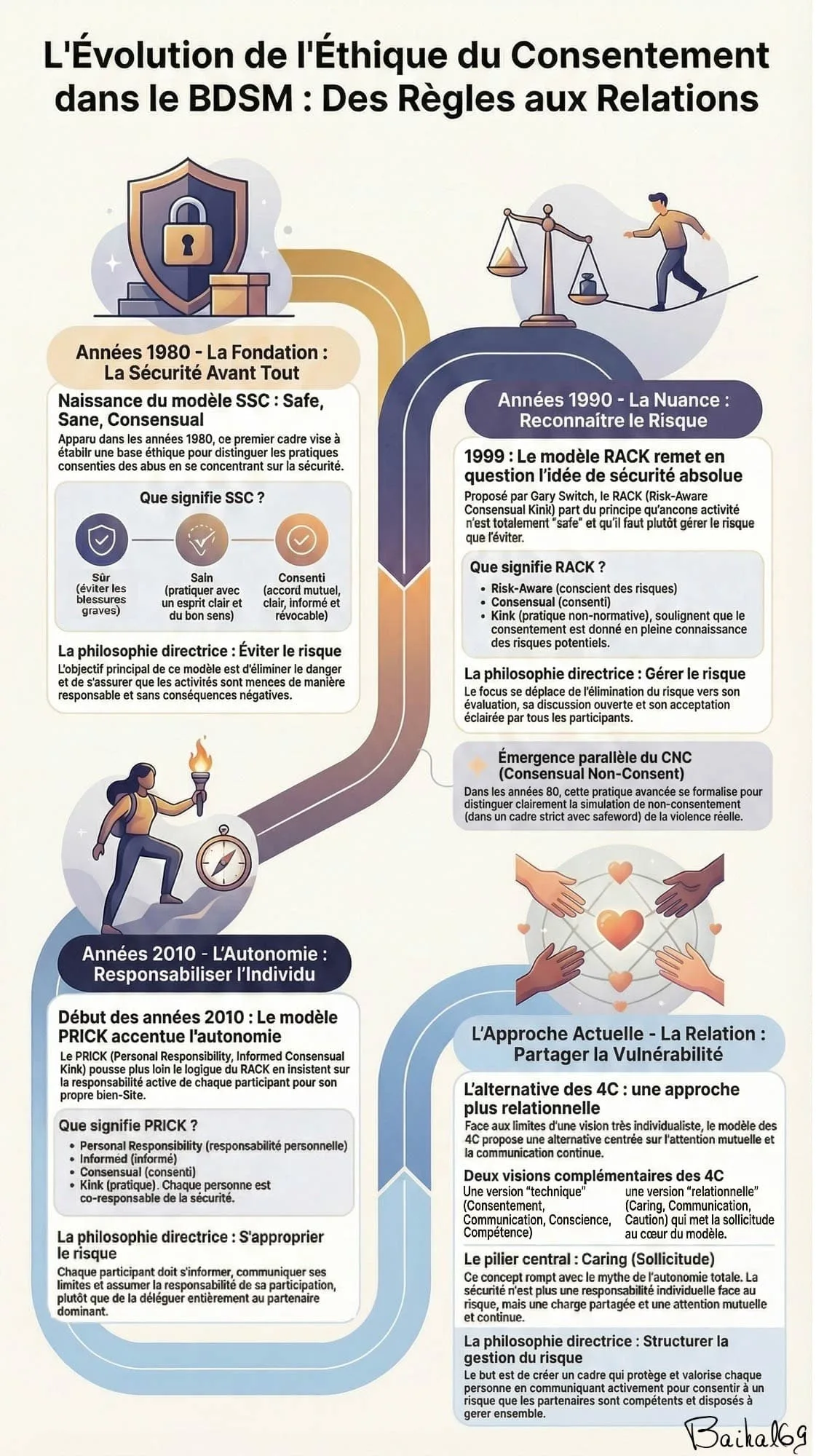
Chapter 3: Consent, an Indispensable Pillar
3.1 Informed and Reversible Consent
In BDSM, consent must be:
- Explicit: each partner understands the implications of the practices.
- Free and without pressure: no forced commitment.
- Revocable: consent can be withdrawn at any time.
3.2 Prior Negotiation
Before any practice, in-depth discussion is essential to:
- Clarify each other's expectations and desires.
- Define personal limits.
- Build a relationship based on mutual trust.
Chapter 4: Communication and Adaptation
4.1 Ongoing Communication
The framework is not static: it evolves with the experience and the needs of the partners. Regular communication makes it possible to:
- Adjust practices along the way.
- Review limits if necessary.
- Improve the quality of the exchange.
4.2 The Importance of Aftercare
After a practice, an exchange session, called aftercare, is highly recommended. It allows:
- Share feelings and emotions.
- Analyze what worked or didn't work.
- Strengthen the bond between partners.
Conclusion
A clear framework in BDSM is not a constraint but a necessity to:
- Guarantee physical and emotional safety.
- Anchor free and informed consent.
- Facilitate open communication.
By structuring interactions, it allows partners to explore their practices in a secure, respectful, and fulfilling environment.
Sources and References
To learn more about the topic, here are some reliable resources:
- American Psychological Association (APA): studies on consent and BDSM practices.
- National Coalition for Sexual Freedom (NCSF): guides on safety and good practices.
- Wiseman, Jay - SM 101: A Realistic Introduction (reference work).
- Royal College of Psychiatrists: analysis of consensual sexual behaviors.
- Wismeijer & van Assen (2013) - Journal of Sexual Medicine: study on the psychological well-being of practitioners.
Never forget to play safely!
Be Geek, Be Kinky!

You may also like

Disability and Sexuality: Breaking Down Taboos for Guaranteed Intimate Fulfillment
Summer infidelity: should you confess everything or protect your relationship by remaining silent?
Is my partner really my soulmate? What science reveals about relationship doubts.
Uniform Fetish: What Your Attraction to Firefighters or Police Officers Reveals About Your Intimate Life
Couple's vacations: when the quest for the perfect photo puts stress in the spotlight.